The Ghazanfari Amraee Clan – "The Lion of the Emirs' Line"
The Ghazanfari Amraee clan has its roots in the mountainous landscape of Lorestan in western Iran. Spanning more than a thousand years, its story tells of people who governed, defended and cared for their homeland, while also living through upheaval and finding new paths as the world around them changed. From the fortresses of the early princes to later generations' contributions to society and literary work, a deep bond emerges with the place, its people and the memory of those who came before.
Roots and responsibility
Lorestan, whose present-day province is roughly the size of Dalarna, lies where the valleys of the Zagros Mountains connect the Iranian plateau with Mesopotamia. The family's history unfolded here in a landscape where distances could be great and personal trust was vital. Tarhan, roughly the size of Dalsland, and its main town, Kuhdasht, became lasting homelands for the clan. The land provided livelihoods and influence, and leadership brought responsibility for people's safety and for relations among towns, villages, families and clans.
In the family's early history, we encounter "Amir" Mohammad and "Amir" Karami, representatives of an already influential family. Their local ties and administrative abilities brought them into the service of the region's sovereign ruler. From these ranks emerged Shoja-al-Din Khorshid, founder of the princely house of Attabakane Lor. His achievements combined military resolve with negotiation and administrative skill. Accounts of his life give particular prominence to easing the tax burden on farmers and reconciling with defeated opponents. Here we find a recurring idea in the clan's history: the strength of a government is closely tied to the trust it can inspire.
The princes of Attabakane Lor ruled through several of Iran's major historical transformations. The power of the Caliphate, Mongol expansion, Timur's campaigns and the growing central authority of the Safavids presented each generation with new challenges. The fortress of Falak-ol-Aflak in Khorramabad became an enduring landmark in the history of the princely house. A vast realm was administered from here, as negotiations and family alliances alternated with defence and conflict. The last reigning prince, Shah Verdi Khan, met his fate in 1597. The fall of the principality changed the family's position, but its local roots and regional leadership endured.
New times and new forms of leadership
In the family's history, Sardar Mir Gheisar Khan Khamé Bidel links the old princely house to the continuing family line. His attempts to preserve its position of power ended in conflict with the Safavid emperor, while his son Mir Ghazanfar Khan carried the branch forward. Through subsequent generations, the family remained influential in Tarhan, Delfan, Selseleh and around Kuhdasht. The titles Mir and Khan endured into a new social order, in which ancient princely rank was combined with service as governors, commanders and administrators of large landed estates.
During the 19th century, Mir Nasrollah Khan emerged as a respected leader and mediator. His sons and their descendants formed several important branches of the family. Tosh-Mal Khan, the elder Amanullah Khan and Fatollah Khan were among those who combined local influence with military and civil responsibilities. Later, Nazar Ali Khan, Amir Ashraf, became one of Lorestan's most influential leaders. His era was marked by political skill and extensive administrative responsibilities, but also by bitter conflicts. The family's history bears traces of both rivalry and reconciliation, and of marriages that brought its branches closer together again.
During the early decades of the 20th century, older traditions of leadership faced an increasingly powerful central government. Ali Mohammad Khan, Amir Azam, and Amanullah Khan, Sardar Bahador, represent different political paths through this transformation. Their lives show how closely the family's fortunes were intertwined with those of the country. Governorships and parliamentary work became new avenues for a commitment to public life that had previously been expressed chiefly through regional rule.
For Sardar Bahador's son Shah Ali-Reza Khan, care for his homeland took tangible form through donations of land and financial support for education, healthcare and municipal facilities in Kuhdasht. A secondary school, a hospital and a public park were among the projects he supported. Here, the long sweep of history becomes tangible in people's everyday lives. An inheritance of land and influence could be transformed into places where children were taught, the sick received care and residents could come together.
Passing on the name and the memory
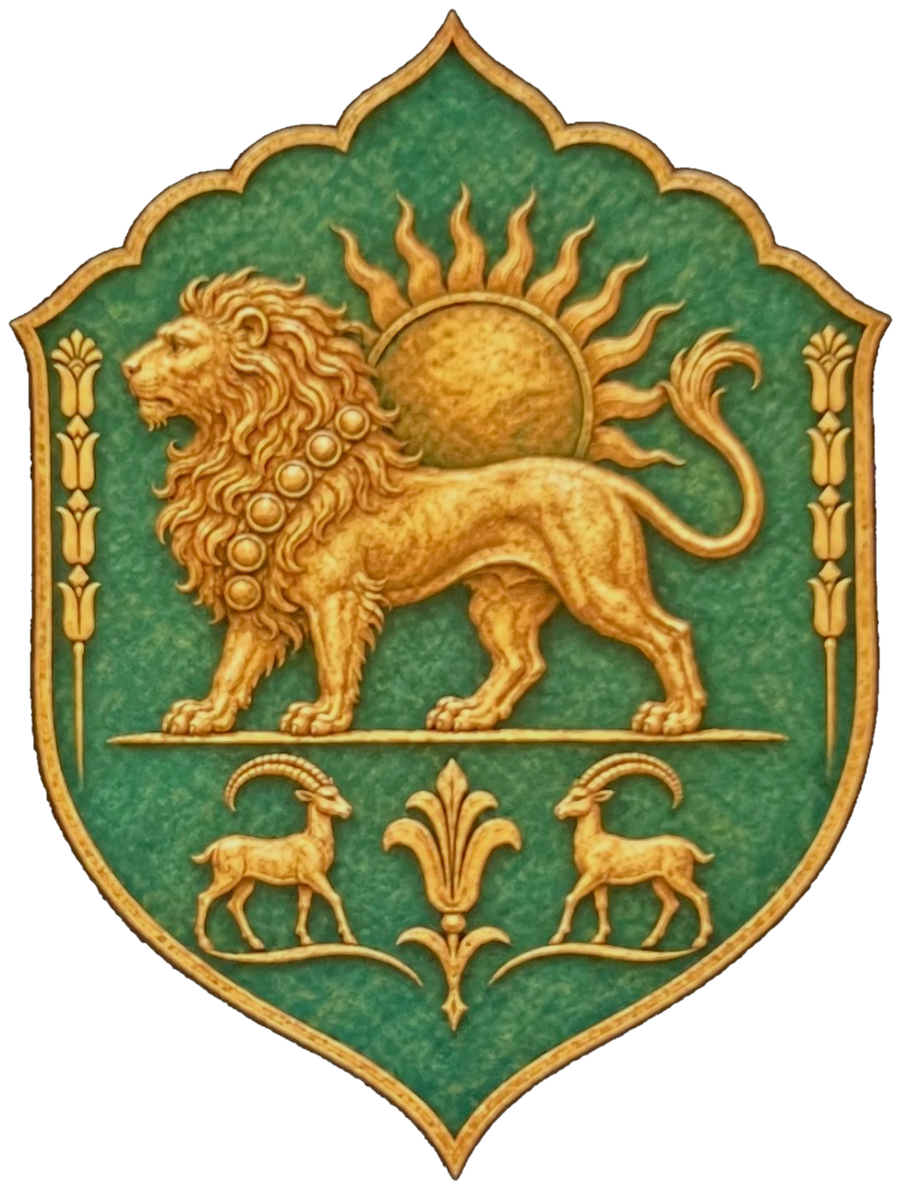
The name Ghazanfari Amraee brings together much of this history. Ghazanfari is linked to Ghazanfar, meaning "lion", and to the lineage of Mir Ghazanfar Khan. Amraee connects the family to its homeland and to Amir, meaning leader or prince. The name's symbolic meaning, "The Lion of the Emirs' Line", finds visible expression in the coat of arms. The lion and the sun recall the imagery on the princely house's coins and Khorshid, whose name means sun. The ibexes, floral ornaments and tree of life take the story deeper into Lorestan's ancient visual traditions. Together, these motifs unite the family's name with the landscape in which its history took shape.
The author, historian and poet Esfandiar Ghazanfari Amraee gave these memories a lasting written form in Tarikh-e Ghazanfari. Through his work, people, events and local contexts have become accessible to later generations. The family's own memories also hold a more intimate history: the homes, the affection and the stories that resurface whenever generations come together.
Today, this heritage lives on through the family's different branches, including those in Sweden. New homes and new settings are woven into the older story. Learning about one's lineage offers a way to understand the lives that made one's own life possible and the choices that shaped the family. This website brings together family trees, photographs and stories to keep that connection alive. Each generation can receive these memories, come to know them and give them a place in its own life.