The starting point of this document is the clan's preserved documents and image material, historical information provided about the Atabegs of Lorestan in history books and the symbols used on the principality's coins, the principality's last ruler Shah Verdi Khan, the clan's other princes, the clan's name and the literature presented especially under the heading Literature and sources.
1. Background: a coat of arms that carries the clan's history forward
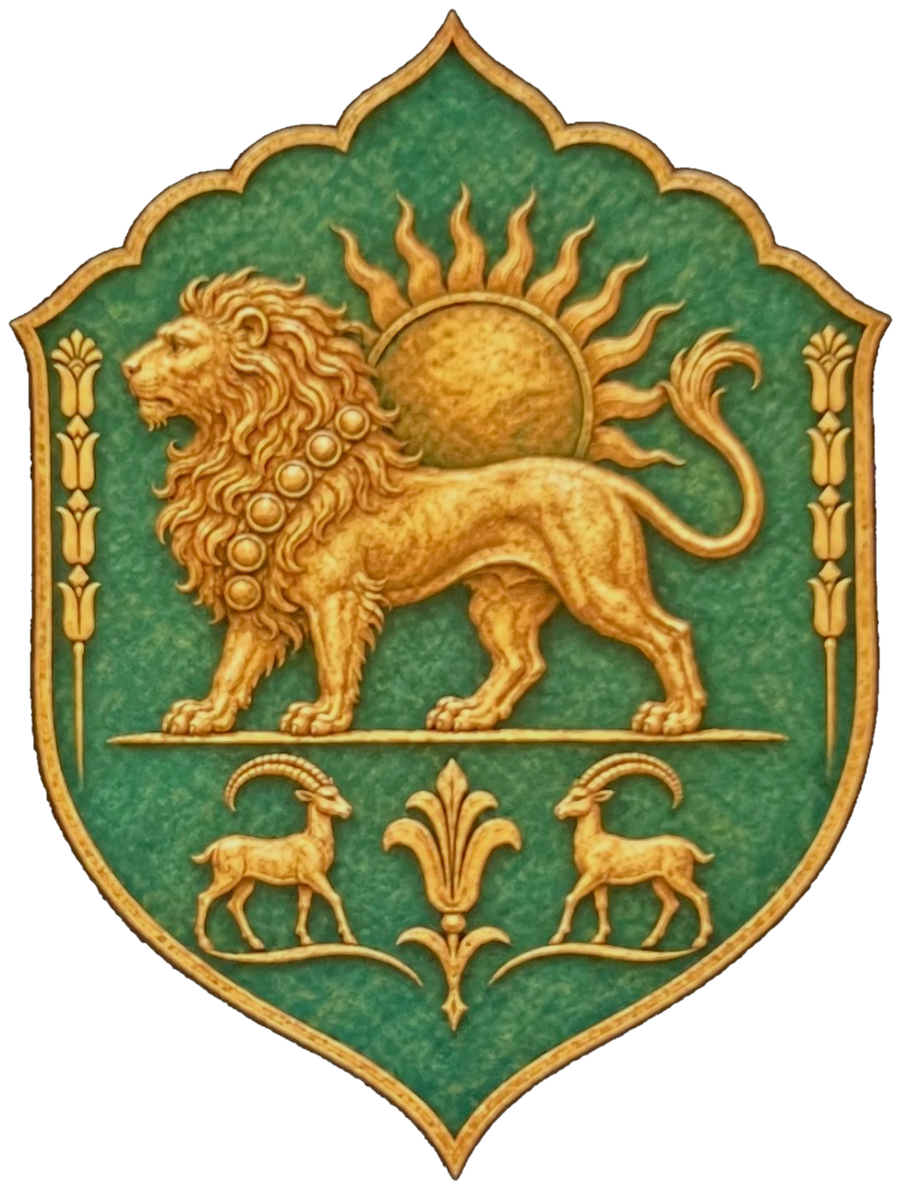
The clan has historically used all the symbols illustrated in the coat of arms. The coat of arms unites the clan's princely tradition with the pictorial motifs used in Lorestan during different historical epochs. Every constituent element has a visible and historical connection between the clan's name, titles, the symbols that marked the clan's older coins, and regional symbolism, all of which together form a coherent family coat of arms.
The central symbols are the lion in front of the sun. The clan's principality in Lorestan was founded by a person named Shoja-al-Din Khorshid, where ”Shoja” means brave and ”Khorshid” means sun. Therefore the clan's principality also goes by the name ”Khorshidi”, i.e. the principality of the sun. The sun symbol has therefore been central to the clan since the beginning of the 11th century. In Persia, the lion has been a common symbol of power, courage, status and executive authority. The clan's princes, and after the fall of the principality in the mid-16th century its members, have always been associated with lions. It is no coincidence that the clan's members after the fall of the principality and after Mir Ghazanfar Khan received the name Ghazanfari, which means lion. The sun and the lion therefore have a direct and strong historical connection to the clan. This is not least evident from the principality's coins preserved from different periods, where one can see the distinctive lion with protruding ears and a medallion around its neck in front of the sun. In addition, there is an even earlier coin motif, where a lion is depicted in a hunting scene chasing an ibex. That is why there are two ibexes, as they have been depicted in Lorestan, in the clan's coat of arms. As ornaments around the lion, the sun and the ibexes, two ancient symbols belonging to Lorestan's pictorial tradition have been illustrated to symbolize the strong and ancient connection to Lorestan.
1.1 A clear hierarchy
The coat of arms is built as a historical narrative in three levels. At the top and in the center stand the lion and the sun: the clan's most important recognition mark. On each side, the historical floral ornament recurs as restrained side markings. Below the lion, the two ibexes meet around a stylized knot and plant motif, which anchors the whole in the principality's motifs from its own coins, connected to the older art of Lorestan.
2. Shah Verdi Khan's coin: the lion and the sun
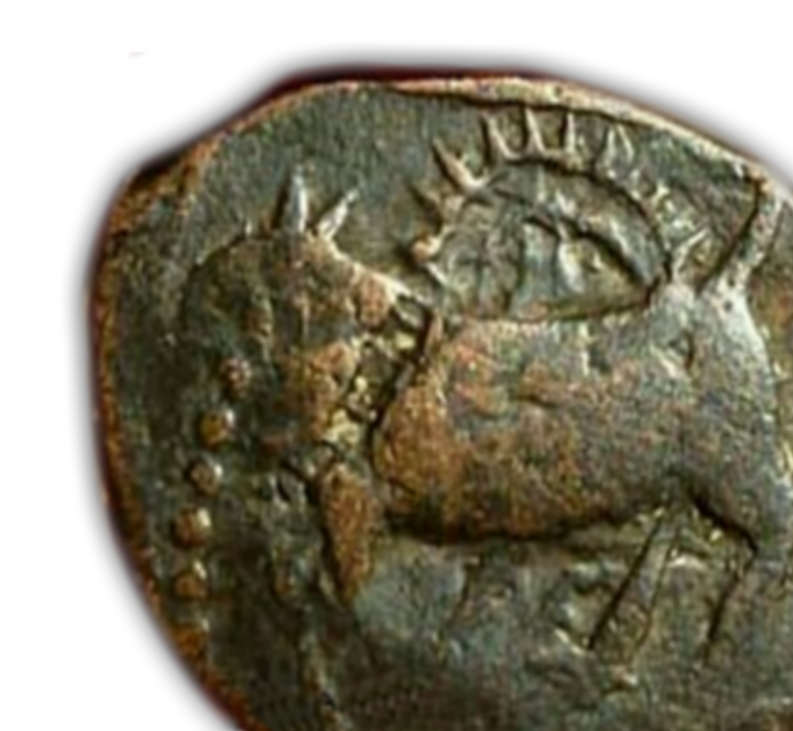
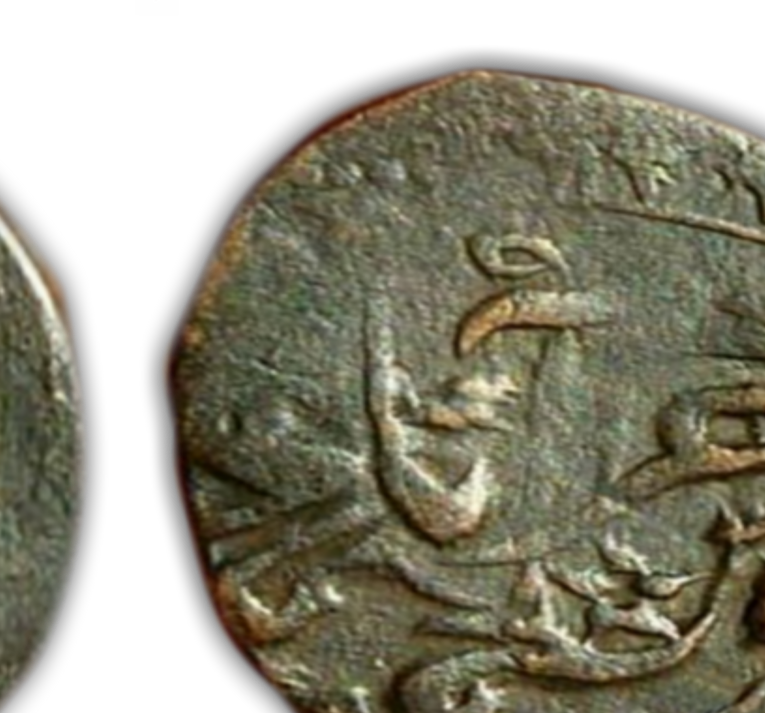
The coin shown below, dating from the late 15th century onwards, constitutes the direct origin of the coat of arms' main figure. On one side of the coin, the lion motif can be discerned, where the lion with its distinctive appearance and visible ears, bearing a characteristic medallion around its neck, is seen, and behind its back the sun disc with radiating rays is visible. For natural reasons, this constitutes the clan's main motif in its coat of arms. On the other side of the coin is written Attabakane Lorestan. During the principality, the clan was called Attabakane Lorestan, i.e. the rulers of Lorestan. More about this can be read under the heading Titles and designations.
2.1 From coin image to shield motif
On the older coin, the lion is small, compact and minted in low relief. On the coat of arms, the same basic figure appears with a larger body, stronger legs and a rich but traditionally designed mane with the medallion around its neck and visible ears. The head is held in profile and the gaze is directed to the left. The lion stands steadily and with dignity instead of being depicted as an aggressive, Western heraldic fantasy animal.
The sun is placed behind the animal's upper body on the same principal basis as in the coin image. The round disc and the undulating rays have been preserved as an independent, strongly recognizable sign.
3. The coin with the hunting scene and the role of the ibexes
The clan's material also includes another, much older coin from Atabeg Lorestan from the 13th century. The motif, which is a hunting motif, shows that a lion with visible ears and a medallion around its neck is hunting a horned animal. The coin introduces a second theme alongside the sunlit lion: the lion's relationship to the wild animals, including the ibex, in the Lorestan landscape where the clan exercised its power.
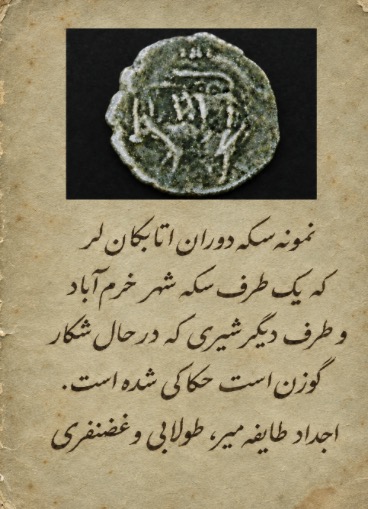
In the clan's coat of arms, the hunting scene has been illustrated by two ibexes, as they have been depicted in Lorestan since time immemorial, standing peacefully and symmetrically under the lion.
The ibex, with its characteristic curved and ridged horn crown, is strongly associated with older Iranian and Lorestan animal ornamentation. In the shield, the animals are depicted with slender legs, relatively simple bodies and clearly backward-curved horns. In this way they recall stylized older depictions, rather than modern zoological illustrations.
4. The first historical ornament: the ”lotus motif”
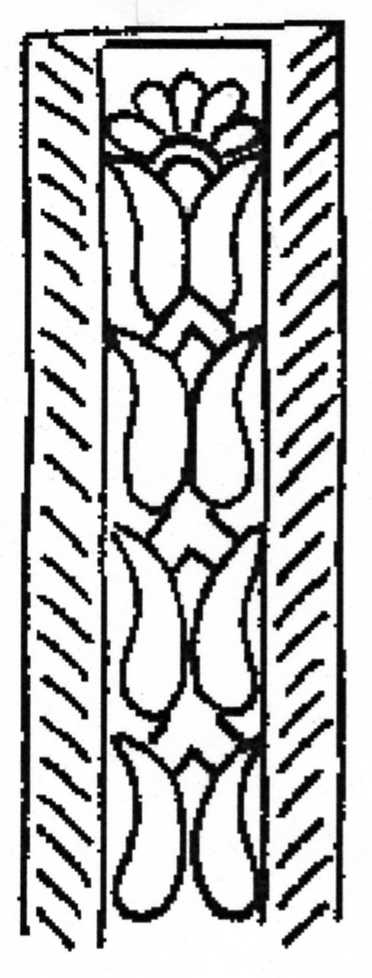
This elongated motif consists of recurring flower forms separated by pointed or diamond-shaped connections. At the top is a more open, crown-like flower. The flower resembles a palmette or a stylized lotus. The vertical rhythm makes the motif particularly suitable as a side decoration: it frames the main image without drawing attention away from the lion and the sun.
Archaeologists have documented Sasanian stucco decoration with lotus motifs, fan-shaped flowers and repeated plant bands that strongly resemble the figure above. Even older parallels exist on a bronze pin from Lorestan in the Louvre, AO 20593, with a band of flowers and palmettes.
This old pattern with a strong connection to Lorestan has been reproduced in gilded relief on each side of the lion. Four stylized flower forms along each side create balance and make the symbol recognizable in a simpler, cleaner form. Thus the historical ornament from Lorestan becomes a real part of the shield's construction rather than a loose decoration.
The main task of the floral pattern is to convey continuity between older Lorestan pattern art and the clan's coat of arms. Its repetition gives regularity, and its subdued gold tone visually merges it with the lion, the sun and the shield's frame.
5. The second historical ornament: the ”tree of life”
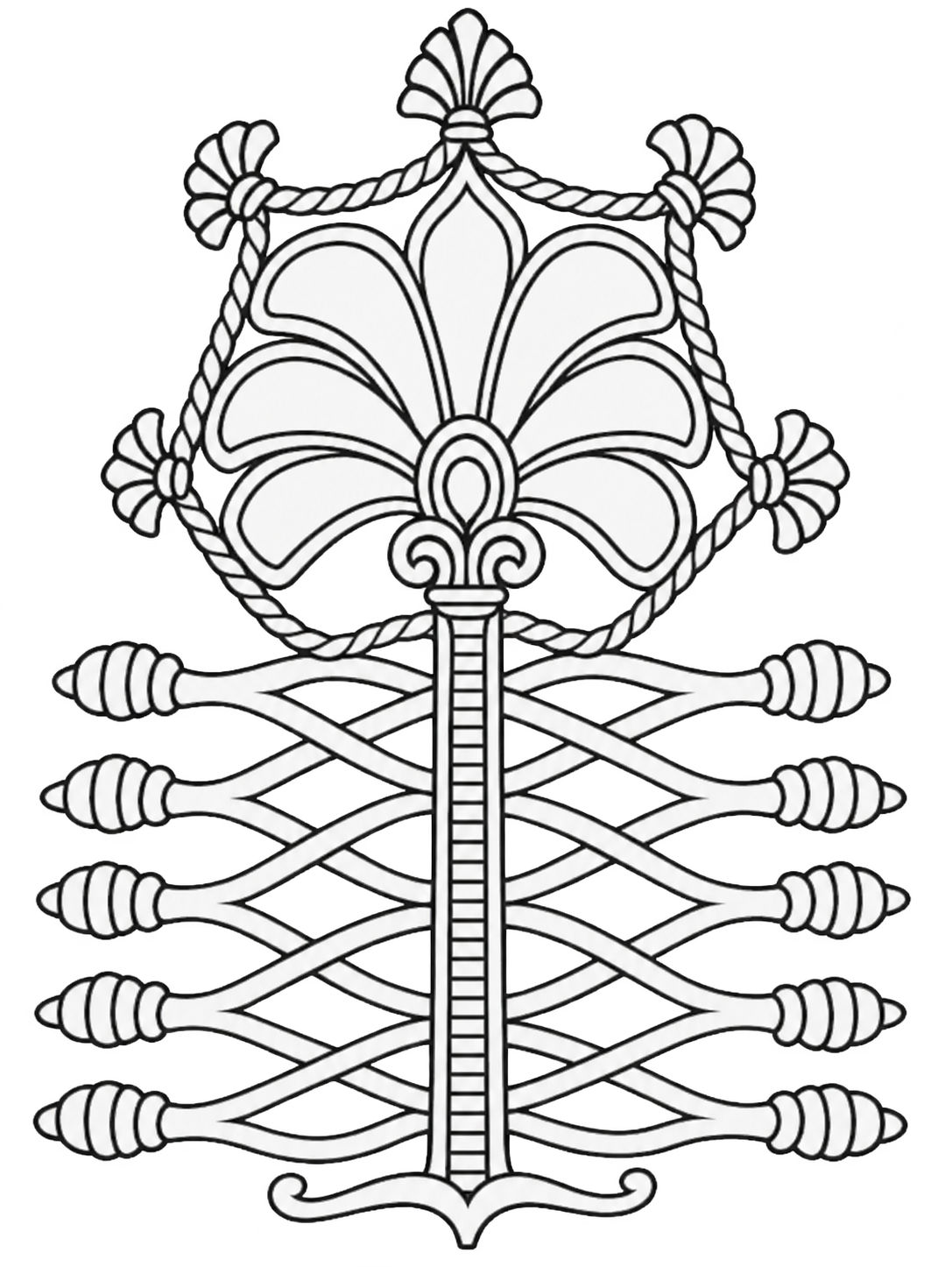
This symbol resembles a sacred tree, often called the tree of life. The combination of a straight central trunk, a fan-shaped crown and crossing bands with bud- or cone-like ends is close to Neo-Assyrian representations of the motif. An example can be found on reliefs from Ashurnasirpal II's palace in Nimrud in present-day Iraq, from the 9th century BC. This type of motif has occurred in Lorestan since time immemorial. On a bronze ring excavated at Surkh Dum in Lorestan, dated to around 900–700 BC, two horned animals stand on either side of a stylized tree with cone-like branches. The Louvre also has a disc pin from Lorestan where two ibexes flank a motif that the museum calls the tree of life or the sacred tree. This type of symbol was used in Lorestan already during the Iron Age.
In the coat of arms it is used in simplified form between the two Lorestan ibexes. The construction of the original figure can still be recognized: the upright central axis, the braided middle part and the plant-like crown. At the same time, the density has been reduced so that the ornament becomes clear.
The placement at the bottom of the shield has a deliberate function. The central ornament becomes a connecting point between the two ibexes and forms a calm foundation under the lion and the sun. In this way, three different motif groups are brought together in a common visual language: the coins' princely lion with sun, the ibex from Lorestan and the regional plant and knot ornament. All of it rests upon and surrounds the ”tree of life”.
5.1 The connection between the parts
The coat of arms has two pictorial levels bound together by the plant ornaments. The lion and the sun in the upper field derive from the coin that in the clan's material is linked to the principality's coins during the 13th and 15th centuries and the last prince Shah Verdi Khan during the first half of the 16th century. The older hunting coin provides a second connection to the lion and forms the basis for the ibexes in the lower field. The hunting scene has been transformed into a symmetrical motif where the ibexes stand facing each other.
The lotus- or palmette-like flower forms along the sides frame the main motif. Between the ibexes, the simplified version of the tree of life forms a central axis under the lion and the sun. The combination of horned animals and a stylized tree has parallels in Iron Age Lorestan. The common gold tone binds the motifs together against the green field, while their placement keeps the princely coin motif in focus.
6. The clan's name: Ghazanfari Amraee
The name Ghazanfari Amraee (also written Ghazanfari Amraei, Ghazanfari Amrai and in Persian script غضنفری امرایی) brings together two meaningful name elements. The first relates to the lion, a classic expression of bravery, strength and dignity. The second anchors the family in the Amraee clan and its historical context in Lorestan, especially Tarhan and Kuhdasht. Together, the name elements create a close symbolic connection with the coat of arms' central lion and with the regional history that the shield's other motifs depict.
6.1 Ghazanfari – the lion as name and ideal
Ghazanfari (غضنفری) is connected with the Arabic word ghazanfar (غضنفر), ”lion”. The word is associated in Persian and Arabic literary tradition with courage, strength and fighting spirit. The name form Ghazanfari can be read as ”belonging to Ghazanfar” or ”of Ghazanfar's lineage”. The Persian dictionary Dehkhoda describes ghazanfar as a word for lion and also uses the meaning of a powerful person. This linguistic meaning gives the lion motif in the coat of arms an additional personal and genealogical resonance: the lion connects a historical coin motif with the meaning of the name.
6.2 Amraee – regional origin and leadership tradition
The name Amraee (امرایی) is closely associated with the Lorestan Amraee clan and with the Tarhan area in western Iran. The name element also relates to Amir, an Arabic word for leader, commander or prince, and to the notion of a ruling lineage. The local and historical meaning emerges particularly through the Amraee clan's role in Tarhan, where its leading khans at various times exercised significant regional influence.
The Persian encyclopedic article on Amraee describes the group as a Luri tribal group in Tarhan, with several named subgroups. It also describes the Amraee khans' leadership within Tarhan's groups and their position in parts of Lorestan. This gives the name element a concrete geographical and social anchoring that complements Ghazanfari's lion meaning.
6.3 The name's meaning in the coat of arms' visual language
As a symbolic summary, Ghazanfari Amraee can be described as ”The Lion of the Emirs' Clan”. The lion stands for the strength of the name, while the shield's regional details point to the family's historical home and connections in Lorestan.
7. Name, history and coat of arms – a common story
The lion in the shield brings together two parts of the clan's history. As a coin motif it belongs to the story of the Atabegs of Lorestan. As a name motif it relates to Ghazanfari and the word Ghazanfar, which means lion. The sun behind the lion brings to mind Shoja-al-Din Khorshid, who in the clan's and historical material is stated to be the founder of the principality, and the designation Khorshidi. The coin associated with Shah Verdi Khan provides the direct model for the shield's main motif.
The name Amraee places the story in Tarhan and around Kuhdasht, where the Amraee clan and its leading khans played a role in Lorestan's history. The ibexes bring both the older hunting coin and the region's animal ornamentation into the shield. The tree of life between them and the floral ornaments along the sides relate to older plant motifs documented in Lorestan. Thus the family's geographical belonging gets a visible expression alongside the princely tradition.
The clan's preserved images and documents give context to the motifs, and Esfandiar Ghazanfari Amraee's historical work carries forward the story of the family and Lorestan in writing. The coat of arms gathers the same story in pictorial form, from the Atabegs' coins and the name Ghazanfari to the Amraee clan's home and Lorestan's older pictorial traditions.
8. Sources and reading references for the supplement
Photographs submitted by the clan: four screenshots with name explanations and historical compilations.
Dehkhoda, dictionary article ”غضنفر” (Ghazanfar)
Persian encyclopedic article ”امرایی” (Amraee)
Esfandiar Ghazanfari Amraee, Tarikh-e Ghazanfari, vol. 1, bibliographic details
Esfandiar Ghazanfari Amraee, Tarikh-e Ghazanfari, vol. 2, bibliographic details